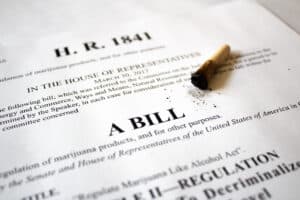
With THC slated to be a hot topic at July’s special legislative session, many Texans are asking where hemp regulation in Texas will fall.
Heather Fazio, Director of the Texas Cannabis Policy Center, said that while Texans could see an over-arching regulatory entity exclusively for cannabis, “I think in the meantime the writing is on the wall with TABC (Texas Alcoholic Beverage Commission).”
“The governor mentioned it in his proclamation,” she said. “We think that there should at minimum be a regulatory division within TABC that’s dedicated to hemp so they have staff that understands the plant, understands consumers and understands the market. But I think that we can expect that this is the direction that our government is choosing to go.”
Fazio spoke at the June 28 “Assembly of Smoke & Strategy” event at Lucyland in New Braunfels, where an audience member posed the question about TABC regulation in the hemp industry.
“This is an adult-use product like alcohol,” Fazio said. “They have boots on the ground, they have the operations already in place. It makes sense that they would go in that direction in spite of my thought, which is that that’s not the most ideal situation.”
While many industry stakeholders echo Fazio’s opinion, she said designating a regulatory body is one of many kinks that will have to be worked out.
“But let us remember that this is the beginning of cannabis being legal forever in Texas,” she said. “There are going to be bumps along the road. We know that even in states like Colorado, they still have to go back every session and fix things or defend things. So the cannabis industry right now is at an inflection point, a maturity point.”
In a stunning display of government overreach, law enforcement officers descended upon three licensed hemp distribution warehouses in Dallas’s Harry Hines district yesterday. The targets — Monster, Frontline Wholesale, and Cannafy Distribution — weren’t criminal enterprises dealing in illicit substances. They were legitimate businesses distributing federally compliant hemp products, complete with lab certifications and QR codes linking to their Certificates of Analysis.
Yet here we are, watching Texas law enforcement raid legal businesses not for breaking existing laws, but in anticipation of legislation that hasn’t even been signed.
The Science They Don’t Want You to Know
Every product seized in these raids came with documentation from DEA-registered, ISO-accredited laboratories confirming compliance with the federal standard: less than 0.3% delta-9 THC. These aren’t back-alley operations — these are businesses following the rules, relying on certified labs and validated testing methods.
But that hasn’t stopped state officials from cherry-picking their science. The Texas Forensic Science Commission has repeatedly warned against the misuse of gas chromatography without derivatization — a testing method that can artificially convert non-psychoactive compounds into delta-9 THC, producing false “hot” results. Instead of heeding these warnings, certain officials have weaponized faulty testing to justify their crackdown.
“They opted for the tests that guaranteed a ‘hot’ result,” explains Jay Maguire, Executive Director of the Texas Hemp Federation. “More raids. Rinse. Repeat. Each one built on a foundation of manipulated science and prosecutorial deception.”
Beware the Badge-Wielding Politician
At the center of this storm stands Allen Police Chief Steve Dye, a man who seems more interested in political theater than public safety. Dye has orchestrated militarized raids on taxpaying businesses, detained veterans and senior citizens at gunpoint, and now finds himself named as a defendant in a federal civil rights lawsuit.
His claims about cannabinoid products would be laughable if they weren’t so dangerous. He insists his jail is filled with cannabinoid victims suffering catastrophic health outcomes — claims that mysteriously don’t appear in Poison Control records or hospital admission logs. When actual hospitalizations do occur, they almost invariably involve alcohol and hard drugs like meth or heroin used simultaneously with hemp products.
When confronted with these facts? Chief Dye “doesn’t want a scientific debate.”
“Steve Dye may wear a police chef’s Stetson, but to the millions of Texans whom his smear tactics and abuse of his office continues to injure, he’s all hat, no cattle,” Maguire observes. “He used discredited science, inflammatory rhetoric, and raw force to build a career off fear — not real science, real facts, or real people, because so far as I can see he’s not interested in real justice.”
The Real Agenda: Control and Corruption
David Sergi, lead counsel for Monster Distribution, doesn’t mince words about what’s really happening here: “This raid was not based on facts. It was based on political theater.”
The enforcement pattern reveals something far more sinister than misguided public safety concerns. This is about collapsing an $8 billion industry to hand the spoils to politically connected licensees. It’s about manufacturing a moral panic to justify a government takeover of a thriving free market.
“The lies and distortions — from the phony outrage on the House floor to dubious claims about ‘poisoning children’ — were never about public safety,” Sergi explains. “They were about consolidating power under the state and its chosen few. It reeks of political favoritism, if not outright corruption.”
Veterans in the Crosshairs
Perhaps the cruelest irony in this saga is how it betrays the very Texans these politicians claim to support. Senate Bill 3, the legislation driving these preemptive raids, would force thousands of veterans, cancer patients, and chronic pain sufferers into the state’s limited medical cannabis registry.
Here’s what they don’t tell you: Under federal law, anyone enrolled in the Texas Compassionate Use Program becomes a “prohibited person” under 18 U.S.C. § 922(g)(3) — meaning they lose their Second Amendment rights.
Think about that. The same politicians who wrap themselves in the flag and champion gun rights are forcing veterans to choose between pain relief and their constitutional freedoms. The same officials who promise to defend the Second Amendment are creating a registry that strips those rights away.
Official Oppression Has a Name
When law enforcement acts outside its authority to deprive businesses and individuals of their rights and property, Texas has a word for it: official oppression. Under Texas Penal Code § 39.03, it’s a crime.
“When state agents knowingly act outside the scope of the law to deprive Texans of their rights or property, they aren’t just overstepping — they’re abusing power,” Maguire states.
These aren’t drug traffickers. These are businesses that have operated legally in Texas for five years, serving customers who overwhelming support access to hemp products. The enforcement actions aren’t about health and safety — they’re about control through “badges and guns.”
The Call to Action
As these raids continue and Senate Bill 3 awaits Governor Abbott’s signature, the Texas hemp industry and its supporters face a critical moment. Will Texas stand for free enterprise, scientific integrity, and constitutional rights? Or will it allow political theater and official oppression to destroy a legal industry that serves hundreds of thousands of Texans?
“Governor Abbott has long stood as a defender of both small business and the Second Amendment,” Maguire notes. “We believe he will see this situation for what it is — an overstep that undermines personal freedom and patient access.”
The message is clear: Veto Senate Bill 3. Stop the raids. Respect the law as it exists, not as some politicians wish it to be. And above all, stop forcing Texans to choose between their health and their constitutional rights. Because when law enforcement becomes a tool of political ambition rather than justice, we all lose.
Austin, TX – State legislators are considering a ban of the sale of all consumable hemp products, leaving the cannabis industry and cannabis advocates in the State of Texas in an uproar.
New cannabis legislation threatens to dismantle a $5.5 Billion industry by bringing an end to the sale of all consumable hemp products in Texas.
This will affect over 10,000 businesses in Texas according to the latest estimates, and over 55,000 jobs will be lost.
“We haven’t abused any loopholes in legislation, because we did not write the legislation nor were we asked to help or assist in the regulations” states Ahmad Alnajjar, owner of Trippiez Smoke Shop. “Everything we have sold and produced has been federally legal with the recent federal farm bill guidelines. We want safety like the legislators do, we WANT proper regulation to ensure safety, abide by the law, and provide the right products for millions of Texans who rely on this as much as we rely on them.”
With five locations in Austin and plans to open an additional location soon, Trippiez Smoke Shop will definitely feel the burn when this legislation is enacted. Imposing fees, creating criminal offenses, and providing an administrative penalty for violations is the primary objective of the new legislation. TX SB3 is sponsored by several members of the state Senate and championed by Lt. Gov. Dan Patrick. Texas legalized hemp-derived products in 2019, but according to the Lt. Gov., retailers have abused this by selling products with a THC level of above 0.3%. CBD and CBG products are exempt provided that they are registered, plainly labeled and in resealable, child-proof containers.
“All the businesses who follow regulations are being punished for the very very few businesses who act carelessly”, protests Alnajjar.
The concerns of those owners who will not have to close their doors is significant, as well. Adjustments will have to be made such as cutting labor costs, and profit will be lost on surplus hemp-derived inventory if not sold before the allotted grace period.
Cheech & Chong: Icons of Stoner Culture. Spotlighted in Blazed Magazine’s May/June 2025 Issue
The May/June 2025 edition of Blazed Magazine pays homage to the legendary comedic duo Cheech Marin and Tommy Chong, featuring cover art inspired by their latest cinematic venture, Cheech & Chong’s Last Movie. This tribute underscores their enduring influence on both mainstream and cannabis cultures spanning the 1970s through the 1990s.
Rising to prominence in the 1970s, Cheech & Chong became synonymous with countercultural humor, delivering iconic performances in films like Up in Smoke, Nice Dreams, and Still Smokin’. Their unique blend of satire and advocacy played a pivotal role in bringing cannabis culture into the public discourse.
Fast forward to today, the duo continues to innovate within the cannabis industry. Their latest product lines, High & Dry THC-infused seltzers and High Tea THC-infused iced teas, are now available at Total Wine locations across Texas. Flavors such as Magic Mule, Raspberry Highball, and Cheech’s Peaches offer consumers a modern, alcohol-free way to enjoy cannabis-infused beverages.
To celebrate these launches, Cheech & Chong are hosting an exclusive meet-and-greet event:
Date: Wednesday, May 14, 2025
Time: 2:20 PM – 4:20 PM
Location: Total Wine & More, 9350 N. Central Expressway, Dallas, TX 75231
Fans can secure a spot by purchasing any Cheech & Chong beverage (High & Dry or High Tea) at any Total Wine location in Texas prior to the event and presenting the receipt or a clear photo of it. The first 250 attendees will receive a limited-edition signed poster and a photo opportunity with the duo.
Cheech & Chong’s continued contributions to entertainment and cannabis culture exemplify their lasting legacy and commitment to innovation.
Each can be heard on previous podcast of the Texas Hemp Show Podcast.
Patrick King, known professionally as The Soil King, made a name for himself in Northern California’s Emerald Triangle — the largest cannabis-producing region in the United States. He was part of the “215 Movement” in 1996, which legalized medical cannabis in California and paved the way for the nation’s broader legalization movement.
“I was the first micro-license given in the state of California and the first solventless rosin-producing company in California (Rosin Tech Labs),” he said.
Today, King travels the world speaking to audiences and promoting his agricultural products — a feat that landed him in Austin for the first time last October for The Taste of Texas Hemp Cup. During that visit, King said he observed something special about The Lone Star State.
“Texas shows up,” he said.
King has watched the tenacity continue in recent months, as advocates have appeared at the state capitol in droves to testify against bills that would ban all or most consumable hemp products.
“Being a pioneer myself to where cannabis is at today, it’s very, very important to show up in numbers and have the support,” King said. “When it came through in Northern California, nobody wanted to show up and do any activism. And that was a problem because there were just a few of us that would go to do all these events, that would show up at the capitol, that would actually read the bills and try to do our due diligence and report back to the community. When we asked the community to show up and help us, they wouldn’t do it.”
While some would offer monetary support, King recalls the reluctance of the community to take a public stand.
“But then when we didn’t get our way, those same people, all they did was cry and complain,” he said. “And my thing is, ‘Hey man, shut up or show up.’ And Texas shows up! That’s what happens here in Texas.”
On April 13, King returned to Austin for a meet and greet at Brite Ideas Hydroponics. He also appeared on the Texas Hemp Show, where he expressed his interest in expanding relationships in the area.
“If anybody wants to do some collabs, I want to get invested in this community,” he said. “I love you guys, I see what you’re doing, and I support you.”
During his time on The Texas Hemp Show, King discussed his passion for living soil and probiotic farming.
“When you’re dealing with probiotic farming, the same soil-born probiotic is the same microbiome as in your body,” he said. “So when you’re growing and get your soils right, you’re producing health to your body, and it’s a reciprocal relationship from earth to soul, and that’s how you get healthy.”
King boasts a “super clean” collection of farming products — including his King Kashi compost and Big Rootz Soil — which can be purchased at thesoilking.com.
Monday morning at 8am the Texas House State Affairs Committee will begin, and will include SB3 on their agenda for the day along with HB 28.
This does not mean that the committee will hear the bill the first thing in the morning. It is possible that other bills may be added and heard first with minimal testimony, just to get them out of the way.
At the time of writing though only the two hemp bills sit on the agenda for the committee that day. It could be expected that many people show up and something similar to what Texans saw in the Senate committee hearing could take place with it being an all day hearing of testimony.
THIS IS THE LAST CHANCE FOR TEXANS TO VOICE ON THE RECORD WHAT THEIR CONCERNS ARE WITH SB3
If you are a shop owner and your livelihood is on the line because of this bill, this hearing should be priority for you. This is the last time and only time in the House that your testimony can go on the official record and everyone gets a chance to testify.
The hearing will take place in the Reagan building in room JHR20. That’s on the 2nd floor of the Reagan Building which can be located on the map above circled in red. You must register at the capitol the day of the hearing to testify. Testimony will be limited to 2 min and the House hearing are usually strict on the 2 min time limit unlike the Senate which gives some leniency.
To submit written testimony to the Texas House, prepare a concise document (ideally under 3-5 minutes worth of reading try to stay within 1 to 2 pages max) and submit it to the committee clerk, along with 20 copies for the committee members, before or during the hearing.
TIPS ON CRAFTING and GIVING TESTIMONY
Stories that are common are not bad, but get repetitive and implicitly unwanted as they become memorable in a more negative light than positive. Give your original perspective, listen to other testify and mold your own verbal testimony to what others have noted as to not overlap so much. It is not advised that one speak on medical topics as though they are medical experts unless they are a medical expert, the Senate is using this against the industry in that it proposed they should be in the medical program (despite its gross limitations).
To go over this again, this is meaning don’t talk like a medical expert or the medical relief it gives you or your clients. Therapeutics is one thing, but discussing THCa like its the fuel for healing everything is not a good move.
If you have any questions, feel free to message us through our contact page, social media accounts Facebook and Instagram, or even on LinkedIn. We want to be organized and professional.
And last but not least, dress business casual or business professional. A good rule of thumb is dress LIKE YOU ARE GOING TO COURT AND GOING TO BE IN FRONT A JUDGE. The Capitol is an official court house and the attire of such meetings is expected to be approximate as such. Dressing as though you are going to a grunge concert in the middle of Iowa give an impression of a lack of concern or care for your attendance and the gravity of the matter at hand.
Just relax and be calm
It is an emotional hell ride at times and the mileage of what you feel may vary. That’s okay. Anger and Sadness are not uncommon, but it is not justification to go into a physical tantrum. It can get you removed from the building and it doesn’t look good. And do not use foul language, it isn’t classy to sound like a salty sailor pulling into Baltimore.
Texas, lets go defend our market and get the right moves made to make our market even better with proper regulations.
Story originally appeared on our with colleagues website at Texas Cannabis Collective:
As the Texas Legislature debates SB 3—a bill that would ban all THC products—responsible hemp retailers across the state are stepping up to protect their businesses, their customers, and their communities.
For the past 18 months, Texas hemp industry advocates, business owners, policy and legal experts have worked to create a set of training modules, model store manuals, SOPs and other compliance-related business standards that can be adopted statewide to assist small businesses with building their compliance and sales capacity while pushing back against the false narratives being used to push the Prohibitionist ban agenda. The Cannabis Retailers Alliance for Texas (CRAFT) is a multi-sector industry-led effort to prove that the hemp industry is capable of self-regulation. Our members have voluntarily implemented a 21+ age policy, adopted rigorous product sourcing and testing standards, and developed a comprehensive Retailer Playbook to help businesses stay compliant in a shifting legal environment.
Our members didn’t wait for politicians to tell them what’s right,” said Jay Maguire, CRAFT co-founder and spokesperson. “Moral panics don’t start with facts—they start with fear. And that’s exactly what Lt. Governor Dan Patrick and Senator Charles Perry relied on: Reefer Madness-style scare tactics and cherry-picked anecdotes. Even when the stories were true, they were outliers—not the norm. The vast majority of retailers are doing the right thing. CRAFT members voluntarily enforce a 21+ age policy and card every customer at the point of sale—just like alcohol and tobacco. That’s what responsible businesses do.”
When Lt. Governor Dan Patrick visited Happy Cactus shop in Austin last week unannounced and looking for evidence of super-high THC products, he was expecting a political “gotcha” moment. What he found instead was a professional, compliant business, stocked with compliant products and operated with trained staff following company policy, carding customers and following best practices. That’s not politics—that’s policy in action.
Key leaders in the hemp space are weighing in:
• Rhiannon Yard, owner of Hemp Gaia, says: “We teach retailers how to verify COAs match the products on their shelves and ensure lab tests were done using the correct methods at accredited labs. That’s how we protect our customers and our licenses.”
• Nick Mortillaro, owner of Lazydaze Coffeeshops, adds: “Retailers need to cut through the buzz and noise with real, evidence-based education. That’s what CRAFT provides.”
• Brian Dombrowsky, owner of Aim High Distro, says: “CRAFT helps business owners stay licensed and build trust by educating their communities about what they do.”
The public already supports this approach. Polls show that 68% of Texans favor safe, regulated access to THC—and the $8 billion Texas hemp market proves they’re voting with their wallets.
To read the full press release or to join the movement, visitjoincraft.org
If you’d like to learn more, speak with a CRAFT spokesperson, or schedule a visit to one of our member retailers, feel free to reach out directly.
Will $475,000 Campaign Help Bring a 4th Quarter Win?
Former Longhorn and Heisman winner Ricky Williams hopes to sway Texas lawmakers on cannabis legislation. He co-founded Project Champion with former NFL athletes Jim McMahon and Kyle Turley. Together, the trio hopes to use their influence — and a $475,000 campaign — to stop Senate Bill 3 in its tracks.
SB3 passed with bipartisan support through the Texas Senate on March 19. If the House passes the bill, it will ban THC in the state and kill an $8 billion industry.
“As former professional athletes, we’ve experienced firsthand the physical and mental toll of high-impact sports,” Project Champion’s website states. “Many of us have turned to cannabis as a natural solution for pain management and overall well-being.
“Recognizing the need for safe, effective and accessible cannabis products, we’ve joined forces to advocate for fair legislation and shatter the stigma surrounding this powerful plant.”
Williams is no stranger to cannabis activism, as he was suspended from the NFL multiple times during his career for positive drug tests. In recent months, the league has loosened regulations surrounding cannabis. In 2023, Chiefs’ Travis Kelce told Vanity Fair that he estimates 80% of players use the substance. On episode 134 of The Texas Hemp Show Podcast, Williams shared that he wished more pro-cannabis athletes would speak out – a mission Project Champion facilitates.
“The stigma is still strong,” he said. “I think people are afraid of it tarnishing their reputation. But to me, a reputation of being something that you’re not and pretending to that you are – not really worth it.”
With their NFL days behind them, Williams, McMahon and Turley have turned over new leaves as cannabis entrepreneurs. In recent years, Williams launched his Highsman brand, while McMahon and Turley have a joint venture called Revenant.
“To me, being an athlete is temporal, and people forget about you – unless you’re the best ever – people forget about you in a generation,” Williams told The Texas Hemp Show in 2023. “What I tell young athletes, I say, ‘Being a professional athlete in the long scheme of your life, it just gives you a platform to do something. But how are you going to use that platform?’ I feel very fortunate that I’ve been able to utilize my platform to touch and help and inspire a lot of people who don’t have any interest in football.”
The athletes work alongside the organization’s president, Gretchen Gailey, a seasoned Washington D.C. journalist who worked in the public affairs space and served as communications director for Congressman Bill Shuster (R-PA).
As part of their nationwide efforts, Project Champion lands earned media telling powerful cannabis stories. They have secured headlines on Forbes, MJBizDaily, Benzinga and Chron (to name a few).
Texas’ 89th Legislative Session ends June 2, and it is not yet clear when the House will vote on SB3. In the meantime, Project Champion plans to launch a digital advocacy campaign, host high-impact events and build coalitions.
Adam Reposa thinks it’s high time for a ‘Me Too’ movement in cannabis. Do you?
“Adam Reposa, His Side Hustle & Hypocrisy in The Hater Dome” is now available on YouTube. The hour-long exposé uncovers layers of absurdities surrounding cannabis politics in The Lone Star State.
The story centers around Austin criminal defense attorney Adam Reposa, who is no stranger to drama and controversy. After years of pulling high-profile stunts, Reposa launched his weed delivery service — ATX Budtenders — in 2022.
The launch coincided with Austin’s decriminalization ordinance. It prohibits Austin police from issuing citations or making arrests for misdemeanor marijuana possession. That is, as long as the incidents are not associated with narcotics or violent felony cases.
Many Texas cities have followed suit with decriminalization efforts, thanks largely to the work of Ground Game Texas. The organization works to advance social justice and strengthen democracy.
Since launching his business, Reposa has openly advertised his services. Law enforcement raided ATX Budtenders in January 2024. Still, authorities have made no arrests or charges, and business continues to boom.
Simultaneously, lawmakers are gathered at the Texas Capitol mulling over Senate Bill 3. The legislation aims to ban all consumable THC products.
Don’t miss this deep dive into plant politics in Texas, which explores the following facts (and so much more):
During the trial, the jury heard evidence about a years-long affair Paxton had on Texas Senator Angela Paxton (as he simultaneously aspires to be the state’s morality police regarding adult cannabis consumption).
Twenty-three Americans are currently serving life sentences for cannabis, according to lifeforpot.org.
SB 3 is on the Texas Senate Intent Calendar for tomorrow, meaning it is eligible for debate and a vote, but that doesn’t guarantee it will be taken up. The Senate convenes at 11 a.m., and the agenda is expected to be full, with multiple bills prioritized for consideration.
Notably, SB 3 is one of at least five bills flagged as high-priority by Lt. Gov. Dan Patrick and could be brought to the floor at his discretion. Because the Lieutenant Governor controls floor recognition, if he decides tomorrow is the day to push forward new regulations on THC, the Senate will take it up accordingly.
That said, I fully expect it to pass through the Senate like shit through a goose—a foregone conclusion given the current political landscape. As we have always known, the real battle lies in the House, where the dynamics are far less predictable, and the outcome may ultimately be decided.
For clarity, since some have asked, this “emergency” designation is political, not constitutional. Some have asked whether this means SB 3 is one of the Governor’s emergency items, which are the only bills that can be voted on in the first 60 days of the 140-day session. It is not—Gov. Abbott did not designate SB 3 as an emergency under the Texas Constitution. Instead, its placement on the Intent Calendar simply means it is eligible for immediate action if Senate leadership chooses to move it forward.
Total Market Value: The Texas hemp-derived cannabinoid industry generates $5.5 billion annually.
• Retail Sales: The retail sector alone contributes $4.3 billion in revenue.
• Overall Economic Impact: The industry supports $10.2 billion in total economic activity.
• Tax Contributions: Hemp-derived cannabinoid sales generate $267.7 million in annual state sales tax revenue.
• Job Creation: The industry employs 53,382 workers, paying out $2.1 billion in wages.
Potential Economic Loss if SB 3 Passes
• Business Closures: Approximately 6,350 businesses would be forced to shut down.
• Job Losses: An estimated 40,201 workers would lose their jobs.
• Wage Decline: Texas workers would lose $1.6 billion in wages.
• Economic Shrinkage: A $10.2 billion reduction in economic activity.
• Tax Revenue Loss: Texas would forgo $267.7 million in annual sales tax.
Industry Health & Growth Trends
• Profitability: 93% of hemp businesses are either profitable or breaking even.
• Retail Growth: The number of registered retail locations increased from 5,072 in 2022 to 7,550 in 2024.
• Wage Increases: Average wages in retail rose from $14.19/hour in 2023 to $17.83/hour in 2025.
• Diversification: The industry has expanded beyond CBD into Delta-8, Delta-9, THCA, CBG, CBN, and HHC products.
• Texas Supply Chain: Most Texas hemp businesses source materials from multiple states but prioritize in-state suppliers.
Regulatory Uncertainty & Business Risks
• Top Business Concern: The primary risk cited by hemp businesses is state and federal regulatory changes.
• Federal Oversight: The FDA has not identified a public safety crisis related to converted cannabinoids.
• State-Level Crackdowns: States that have enacted similar restrictions, like Oregon, saw millions in lost revenue and disrupted supply chains.
Policy Recommendations
• Avoid Prohibition: Rather than banning hemp-derived cannabinoids, regulation should focus on product safety, age restrictions, and clear labeling.
• Support Economic Stability: Restricting the industry would disrupt thousands of jobs and millions in tax revenuewithout clear public safety benefits.
• Encourage Collaboration: A balanced regulatory approach could maintain public safety while allowing Texas businesses to continue growing.
“Who are you going to believe, me or your own lying eyes?” — Groucho Marx, noted comedian and cigar enthusiast
This week’s release of the Whitney Economics study on the Texas Hemp Industry should have been an eye-opener—at least for anyone willing to acknowledge reality. The more I review the numbers and rhetorics surrounding SB 3, the clearer it becomes that this isn’t about responsible regulation—it’s a deliberate effort to mislead the public and lawmakers while dismantling a thriving industry.
It would be almost laughable if it weren’t so blatant. On one hand, Sen. Perry ignores a vast body of evidence, from thousands of constituent testimonials to gold-standard, peer-reviewed studies demonstrating the safe and effective health benefits of cannabinoids. Instead, he insists that hemp retailers are preying on Texas children, addicting them, and causing untold harm to millions.
At the same time, the Comptroller of Public Accounts’ fiscal note—the official economic impact analysis provided to the legislature—downplays the industry’s contribution to the state, suggesting that Texas hemp businesses generate only $10 million per year in tax revenue. The reality? It’s at least TWENTY TIMES that amount.
So which is it? Is the Texas hemp industry so big, fearsome, and dangerous that it must be slashed down to size? Or is it so small and insignificant that lawmakers can vote to ban its products without fear of economic repercussions in their districts? They can’t have it both ways.
What’s happening here is not policymaking—it’s prohibition masquerading as regulation, built on fearmongering and bad math.
Flawed Fiscal Note: Bad Data, Worse Assumptions
The fiscal note attached to SB 3 is deeply flawed, significantly underestimating the economic impact of the Texas hemp industry. The Comptroller’s office arrived at its revenue projections based on an indefensible assumption: that a small sample of hemp retailers in Austin accounts for 25% of all sales statewide.
There is no data to support this claim, yet this flawed assumption forms the foundation of the state’s economic analysis of SB 3.
By contrast, Whitney Economics conducted a comprehensive, data-driven study of the industry and found:
• The Texas hemp-derived cannabinoid industry generates $5.5 billion annually.
• It employs more than 53,300 Texans, with $2.1 billion in wages.
• It contributes $267.7 million annually in state sales tax revenue.
• The retail sector alone produces $4.3 billion in sales, with manufacturing and wholesale adding another $1.26 billion.
Instead of considering this robust statewide industry, the Comptroller’s analysis relied on tax returns from a handful of vape shops in Austin, assumed those stores represented one-quarter of the entire state’s market, and extrapolated from there.
This is not a credible methodology. It grossly understates the economic fallout that SB 3 will cause.
The True Cost of SB 3
The fiscal note estimates only a $27 million loss in state revenue over two years. But it ignores the full economic impact of dismantling an industry of this scale.
According to Whitney Economics, the actual consequences would be far greater:
• $3.1 billion in lost retail sales
• $194.9 million in lost tax revenue
• 40,201 jobs eliminated
• $1.59 billion in lost wages
• $7.5 billion in total economic losses
This bill won’t just hurt individual business owners—it will have far-reaching economic consequences for:
• Commercial real estate (as retailers shut down storefronts across Texas).
• Supply chains (manufacturers, wholesalers, and logistics providers will be impacted).
• Local economies (thousands of Texans will lose their jobs and spending power).
The fiscal note, by narrowly focusing on direct sales tax revenue, fails to account for these larger disruptions.
Misinformation and Fear Tactics
Beyond the faulty fiscal analysis, SB 3’s backers are relying on scare tactics and misleading testimony to push the bill forward.
When veterans, chronic pain sufferers, epilepsy patients, and other Texans testify about the life-changing benefits of hemp-derived cannabinoids, proponents of the bill deflect by cherry-picking isolated incidents and misrepresenting their significance.
At the Senate State Affairs Committee hearing, I saw this firsthand. A witness gave an emotional testimony about a family member’s death, strongly implying that cannabis was to blame. But when the microphones were off, another witness calmly asked what actually happened.
Her response? “It was drugs, OK?”
This kind of vague, unverified testimony is being weaponized to justify dismantling a legitimate industry. Sen. Perry then seized on this uncorroborated story, using it as justification to attack law-abiding business owners.
This isn’t policymaking—it’s prohibition by way of fearmongering.
The Bottom Line
SB 3 is not about protecting the public—it’s about eliminating a $5.5 billion industry under the guise of regulation. The fiscal note is built on faulty assumptions, and the narrative supporting this bill is driven more by a political agenda than by facts.
The March 3 hearing showcased the best anti-THC talking points from the 1970’s, 80’s and beyond. Like a hit parade of bogus tunes, here’s the Top Ten Prohibitionist Lies
1. “Marijuana is a Gateway Drug”
• Falsehood: Using marijuana leads people to use harder drugs like heroin or meth.
• Reality: Numerous studies, including from the National Institute on Drug Abuse (NIDA), show no causal link between marijuana use and subsequent hard drug use. The real gateway factors tend to be socioeconomic conditions, trauma, or early exposure to addictive substances like alcohol and nicotine.
• Reality: Crime statistics from states that have legalized cannabis (e.g., Colorado, Washington) show no significant rise in violent crime—and some cities have even reported decreases. In contrast, illegal drug trade violence often decreases when legal markets replace black market sales.
3. “Marijuana Lowers IQ and Makes People Lazy”
• Falsehood: Long-term cannabis use reduces intelligence and destroys motivation.
• Reality: Studies show no significant IQ drop in adults who use cannabis. While adolescent overuse may impact cognitive development, occasional adult use has not been linked to measurable declines in intelligence. Moreover, many successful professionals and creatives openly use cannabis without suffering motivational issues.
4. “Marijuana is as Dangerous as Heroin and Fentanyl”
• Falsehood: Cannabis is a “Schedule I drug” because it’s highly addictive and has no medical benefits.
• Reality: Marijuana is not chemically addictive in the way opioids or nicotine are, and it has established medical benefits for pain, epilepsy, PTSD, and more. In fact, it is far less harmful than alcohol and prescription painkillers.
5. “Legalization Leads to More Teen Use”
• Falsehood: When states legalize marijuana, more teenagers will start using it.
• Reality: Studies from The Journal of the American Medical Association (JAMA) and Colorado Department of Public Health show no increase in youth marijuana use post-legalization. In fact, some states have seen decreases in underage use due to better regulation.
• Reality: This myth originated from a flawed 1970s study where researchers suffocated monkeys with excessive cannabis smoke, depriving them of oxygen. Modern neuroscience shows that cannabis affects brain function but does not destroy brain cells.
7. “People Overdose on Marijuana”
• Falsehood: Cannabis use leads to lethal overdoses.
• Reality: There are zero recorded deaths from cannabis overdose. While high doses can cause discomfort, anxiety, or nausea, it does not suppress respiratory function like opioids.
8. “Legal Marijuana States Have More DUIs and Traffic Accidents”
• Falsehood: Marijuana legalization leads to more impaired driving and crashes.
• Reality: While THC can impair driving ability in some cases, overall crash rates have not spiked in legal states. Many studies indicate that drunk driving is a far bigger problem than cannabis-impaired driving.
9. “Marijuana Has No Legitimate Medical Use”
• Falsehood: There is no scientific evidence supporting medical marijuana.
• Reality: Cannabis is FDA-approved for multiple conditions, and studies confirm its effectiveness in treating epilepsy (CBD), chronic pain, nausea from chemotherapy, PTSD, and multiple sclerosis. The U.S. government even holds a patent on cannabinoids for their neuroprotective effects.
10. “Marijuana Legalization Harms the Economy”
• Falsehood: Legal weed will damage businesses and hurt the economy.
• Reality: Legal cannabis is one of the fastest-growing industries, generating billions in tax revenue, creating hundreds of thousands of jobs, and reducing costs related to law enforcement
The media landscape in America is undergoing a seismic shift. Traditional cable TV, once the dominant source of political news, is losing its grip as Americans increasingly turn to YouTube for information and analysis. This transformation is fueled by the platform’s accessibility, diversity of content, and ability to connect with audiences in ways cable TV simply cannot. Here’s a look at how YouTube has become a primary source of political news and analysis for millions of Americans, exemplified by some of the most influential political podcasts.
—
Why Americans Are Turning to YouTube for Political News
1. Diverse Perspectives: Unlike cable TV, which is dominated by a handful of networks with clear political leanings, YouTube offers a vast array of voices from across the political spectrum. This diversity allows viewers to explore multiple perspectives and form their own opinions.
2. On-Demand Content: Cable TV operates on a fixed schedule, while YouTube allows viewers to access political discussions anytime, anywhere. This flexibility is especially appealing to younger audiences accustomed to consuming content on their terms.
3. Unfiltered Conversations: YouTube video podcasts often feature long-form discussions that dive deeper into topics than the soundbites and curated debates on cable news. This format fosters nuanced conversations and provides a more comprehensive understanding of issues.
4. Direct Engagement: Viewers can comment, share, and interact with content creators, fostering a sense of community and dialogue. This level of engagement is missing from traditional cable TV.
5. Distrust in Traditional Media: Growing skepticism about mainstream media bias has led many Americans to seek alternative sources of news and analysis. YouTube’s decentralized model gives independent creators the freedom to address topics that cable networks might avoid.
—
The Rise of Political News Podcasts on YouTube
Here are 10 of the most influential YouTube video podcasts that illustrate how Americans are consuming political news in the digital age:
It’s not on the list but is one of the most politically-heated personalities in talk podcasting for Obvious reasons is Tucker Carlson on X.
The former FOX News anchor has broken out on his won with plenty of success after being let go from Fox in late 2023.
1. The Joe Rogan Experience
Impact: Joe Rogan’s discussions often touch on political issues, featuring guests from all sides of the spectrum. His open-ended format allows for in-depth exploration of topics rarely covered by mainstream media.
Why It Works: Rogan’s authentic, conversational style resonates with audiences tired of scripted debates.
2. The Alex Jones Show (on X)
Impact: Known for its provocative content, Alex Jones’ show delves into controversial political topics. His unapologetic approach attracts viewers seeking alternative perspectives.
Why It Works: Offers a counter-narrative to mainstream political reporting.
3. PBD Podcast (Valuetainment)
Impact: Patrick Bet-David invites politicians, thought leaders, and entrepreneurs to discuss the intersection of politics, economics, and culture.
Why It Works: Combines analytical depth with actionable insights, appealing to politically curious viewers.
4. Redacted
Impact: This podcast explores geopolitics and U.S. domestic issues, often critiquing mainstream media narratives.
Why It Works: Provides alternative analyses of global and national events, empowering viewers to question the status quo.
5. The Sean Ryan Show
Impact: Hosted by a former Navy SEAL, this show often examines politics through the lens of military and national security issues.
Why It Works: Combines expertise with candid conversations, offering a fresh take on political topics.
6. The Danny Jones Podcast
Impact: Danny Jones tackles political and social issues, often inviting diverse guests to provide unique perspectives.
Why It Works: Covers controversial topics with a bold, open-minded approach.
7. Piers Morgan: Uncensored
Impact: Piers Morgan interviews politicians and cultural figures, offering sharp commentary on current events.
Why It Works: Combines traditional journalistic expertise with modern, opinion-driven discourse.
8. Michael Franzese
Impact: While primarily known for sharing stories from his mobster past, Michael Franzese often touches on political themes, connecting historical and modern dynamics.
Why It Works: Blends personal anecdotes with political insights, creating a unique storytelling format.
9. Next News Network
Impact: An independent news outlet providing breaking news and political commentary, often critical of mainstream media narratives.
Why It Works: Appeals to viewers seeking alternative reporting on national and global events.
10. The Rubin Report
Impact: Dave Rubin’s show fosters discussions on politics, free speech, and cultural issues, often featuring high-profile guests.
Why It Works: Promotes intellectual dialogue and open debate in a polarized media environment.
The Future of Political News Consumption
As YouTube continues to grow, its influence on political discourse will only deepen. Here’s what this shift means for the future of media:
1. Decentralization of Power: The rise of independent creators is reducing the dominance of traditional media conglomerates.
2. Empowered Audiences: Viewers now have the tools to explore diverse viewpoints and make informed decisions.
3. Greater Accountability: The interactive nature of YouTube fosters a two-way conversation between creators and their audiences, encouraging transparency.
4. Challenges of Misinformation: While YouTube democratizes content creation, it also requires viewers to critically assess the credibility of their sources.
People simply are not buying fake news networks today. Americans and global cultures are evolving and influence is not limited to simply the Big Corporations anymore.
The migration of political news consumption to YouTube reflects a broader desire for authentic, accessible, and diverse content. These video podcasts are not just replacing traditional cable TV—they’re shaping the future of how Americans engage with politics in the digital age.
Inside the sprawling halls of MJBizCon 2024, amid the neon-lit booths and the endless
hum of conversations about cannabis futures, you’ll find a man in a jacket that sparkles
like a Vegas marquee. He’s wearing Balenciaga sneakers, sportin’ a diamond-encrusted
watch and carrying himself like a rock star. But make no mistake: Josh Kesselman is no
ordinary trade show figurehead. He’s the founder and driving force behind RAW, the
iconic rolling paper brand that has turned an age-old art into something of a cultural
movement.
Across the enormous convention space, fans stop him for pictures, journalists vie for a
moment of his time, and industry insiders pause just to see what he’s unveiling next. He
looks equally at home here among executives and connoisseurs as he does in the
small, centuries-old Spanish paper mills where his products are made. If RAW is the
name on everyone’s lips, Josh Kesselman is the reason.
A Childhood Spark and a Family Legacy
Kesselman’s journey began long before legalization changed the landscape. It’s a story
he’s told time and again, yet it never seems to lose its magic. Growing up in New York,
a young Josh watched his father perform a simple but astonishing trick: lighting a rolling
paper on fire and letting it vanish into thin air. For a five-year-old, it was an unforgettable
bit of sorcery—an everyday object turned into pure enchantment. That rolling paper
became a symbol, a spark lighting the fuse of an obsession that would fuel Josh’s
career.
Years later, that wide-eyed kid became a savvy entrepreneur with a singular passion:
bringing the purest, thinnest, most natural rolling papers to smokers everywhere. While
most people looked at rolling papers as a mere commodity, Josh saw something
different—a canvas for improvement, a frontier wide open for innovation. It was never
about following what had been done; it was about reaching for what could be done.
Building a Better Mousetrap
From the outset, Kesselman took inspiration from his grandfather’s “mousetrap theory.”
The idea was simple: Make a better product, and the world will beat a path to your door.
Rather than replicate what was already on shelves, Kesselman set out to reinvent
rolling papers—stripping them of chemicals, chalk, and bleach, insisting on natural
fibers and an ultra-thin profile that enhanced flavor rather than masked it.
In the 1990s, he opened a modest smoke shop in Gainesville, Florida, where he learned
his first real business lesson: listen to customers’ needs and exceed their expectations.
He catered to niche tastes, tracking down rare European papers that, to Americans,
seemed exotic and transformative. He learned that true connoisseurs craved
authenticity and quality. That insight guided him as he developed Elements and Juicy
Jays, and it ultimately led him to the crown jewel of his career: RAW.
When RAW first launched, the market didn’t quite know what to think. Customers were
used to bright-white papers that had been bleached and thickened with additives.
RAW’s unrefined, brownish, translucent paper looked different—and tasted different,
too. It wasn’t an instant hit. But Kesselman wasn’t rattled. He knew that once people
tried them, once they actually tasted the purity of their plants instead of their paper,
RAW would sell itself.
From Smoke Circles to Celebrity Endorsements
No TikTok hype or Instagram influencer planted RAW in the world’s consciousness—it
was smoke circles. RAW found its way into the hands of discerning smokers who
shared joints at weekend gatherings, passing them from friend to friend, converting
each new person into a believer. Word-of-mouth became the brand’s secret
superpower, and these social rituals turned RAW into a quiet revolution. Before Josh
knew it, RAW started popping up in songs and on stages. The first rapper to sing its
praises was Curren$y, who loved the papers so much he introduced them to Wiz
Khalifa, who then folded RAW into his music and persona. Suddenly, RAW wasn’t just a
preferred paper; it was a cultural statement, a badge of honor that aligned
connoisseurs, celebrities, and the average smoker alike.
A Relentless Pursuit of Perfection
At MJBizCon 2024, Kesselman teased a collaboration with premium vape maker
CCELL—a device under the working title “RAW-sin,” tailored for live rosin vaping. He’s
also at work on the next generation of his Raw Ethereal line, which he proudly claims is
“the thinnest unbleached rolling paper in the world.” Soon, these ethereal cones will hit
the market, promising an experience unlike any smoker has tried before. For
Kesselman, this isn’t just product development; it’s a quest to create the “best products
in the history of smoke-kind.” It’s a lofty goal, but lofty goals are what he does best.
As he puts it, each new product must be better, more honest, and more forward-thinking
than the last. If a product doesn’t hit the mark, if it doesn’t delight and surprise, he views
it as a failure. Every sheet of paper that comes off that Spanish mill’s line should be
nothing short of exceptional—otherwise, what’s the point?
Hard on Staff, Kind to the World
Kesselman’s pursuit of excellence is famously exacting. He admits he can be tough on
his staff because the standard he sets is unwavering. Yet the ethic he fosters is one of
service: Humans are here to help each other, he often says, and if RAW falls short of
that ideal, he and his team haven’t done their job.
This philosophy extends beyond product perfection to philanthropy. The RAW
Foundation has funded numerous humanitarian projects, from drilling water wells in
Ethiopia to supporting reforestation efforts worldwide. It’s not marketing; it’s a moral
imperative—an extension of the brand’s authenticity and heart.
Leading, Not Chasing
By the time you read this, there may be a handful of so-called “RAW imitators” on the
shelves. Kesselman welcomes that competition as confirmation of his mousetrap theory.
After all, if they’re imitating him, it means he’s leading. “As long as we’re leading the
way and they’re behind us,” he says, “that’s great!” And leading the way means
continuous refinement—like a perpetual R&D mission to deliver papers that burn
cleaner, taste purer, and elevate the overall smoking ritual.
A Community Built on Trust
At its core, RAW is a brand built on trust, camaraderie, and a mutual appreciation for the
craft. While legalization and commercialization have reshaped the cannabis world,
Kesselman’s message remains unchanged: authenticity and quality will always prevail.
He took a niche idea—ultra-natural rolling papers—and discovered that everyone, from
hippies to rappers, wants the best.
Josh Kesselman transformed a childhood memory into a global phenomenon. He didn’t
simply create a product; he built a movement. That’s why, as he stands on the trade
show floor—dressed to the nines, eyes gleaming with the excitement of what’s
next—people gravitate toward him. Because beyond the bright lights and the new
products, they see someone who never forgot the magic of a disappearing paper trick
and channeled that wonder into building a better world for smokers everywhere. And as
long as that magic endures, RAW’s empire will continue to flourish, one puff at a time.
The Drone Deception: A Psyop to Push the Narrative of a Fake Alien Invasion
In recent years, reports of unidentified aerial phenomena (UAPs) have surged, with mainstream media and government agencies amplifying the mystery surrounding these incidents. However, beneath the surface of these headlines lies a compelling and unsettling theory: these drones are not extraterrestrial but rather part of an elaborate psyop orchestrated by Deep State operatives to mislead the public and propagate a deceptive narrative.
The Deep State’s Hidden Agenda
At the heart of this theory is the belief that the Deep State—a shadowy coalition of government, military, and corporate interests—controls advanced technologies and uses them to manipulate public perception. The drones that have captured the public’s imagination are likely U.S. Navy or NASA-operated assets, deployed strategically to create the illusion of unidentified or extraterrestrial origins.
This operation is not a random occurrence but a calculated effort to steer global narratives. By using these drones to foster speculation about alien life, the Deep State can distract from other pressing issues, unify global populations under a fabricated threat, and justify expanded military budgets and surveillance powers.
The Role of the Media
Mainstream media has long been accused of being complicit in state-sponsored propaganda. In this case, it appears they have received marching orders from the Pentagon to perpetuate the mystery of these drones. Despite possessing the resources and investigative capabilities to uncover the true nature of these technologies, media outlets continue to describe them as “unknown” or “unexplained.”
By doing so, they amplify the aura of uncertainty and wonder, nudging public opinion toward a narrative of extraterrestrial involvement. This serves the Deep State’s goals, ensuring that the population remains captivated and distracted while larger geopolitical or technological plans unfold behind the scenes.
The Project Blue Beam Connection
This theory aligns closely with discussions of Project Blue Beam, a purported operation designed to deceive global populations through advanced technologies. Project Blue Beam allegedly involves:
Light Show Technology: Holographic projections capable of simulating celestial phenomena, alien spacecraft, or religious figures.
High-Frequency Audio: Techniques to create voices or sounds directly in the minds of unsuspecting individuals.
Satellite Imagery: Tools to produce convincing visuals of events in the sky, further solidifying the illusion of extraterrestrial activity or divine intervention.
The drones observed today could be a precursor to such a staged event, testing public reactions and fine-tuning the technological capabilities required for a large-scale deception.
The Endgame: A New World Order
The ultimate goal of this psyop, according to the theory, is to establish a New World Order. By uniting humanity under the threat of a common enemy—whether aliens or some other fabricated menace—the Deep State can consolidate power, impose stricter controls, and reconfigure societal structures to serve their interests.
This strategy aligns with historical patterns, where fear and crisis have often been used as tools to expand government authority. The alien invasion narrative is merely the next iteration of this tactic, leveraging cutting-edge technology to achieve unprecedented levels of influence.
Conclusion
While skeptics may dismiss this theory as conspiratorial, it invites critical examination of the narratives fed to us by powerful institutions. Are we witnessing genuine unidentified phenomena, or are we being manipulated by a calculated campaign of deception?
The truth may lie hidden in the shadows, but questioning the official narrative is the first step toward uncovering it. As we continue to explore these phenomena, it is crucial to remain vigilant, skeptical, and aware of the broader context in which these events unfold.
In the end, the drones may not be a harbinger of alien life but a stark reminder of how easily perception can be shaped by those in power.




 To read the full press release or to join the movement, visit

 512-954-8054